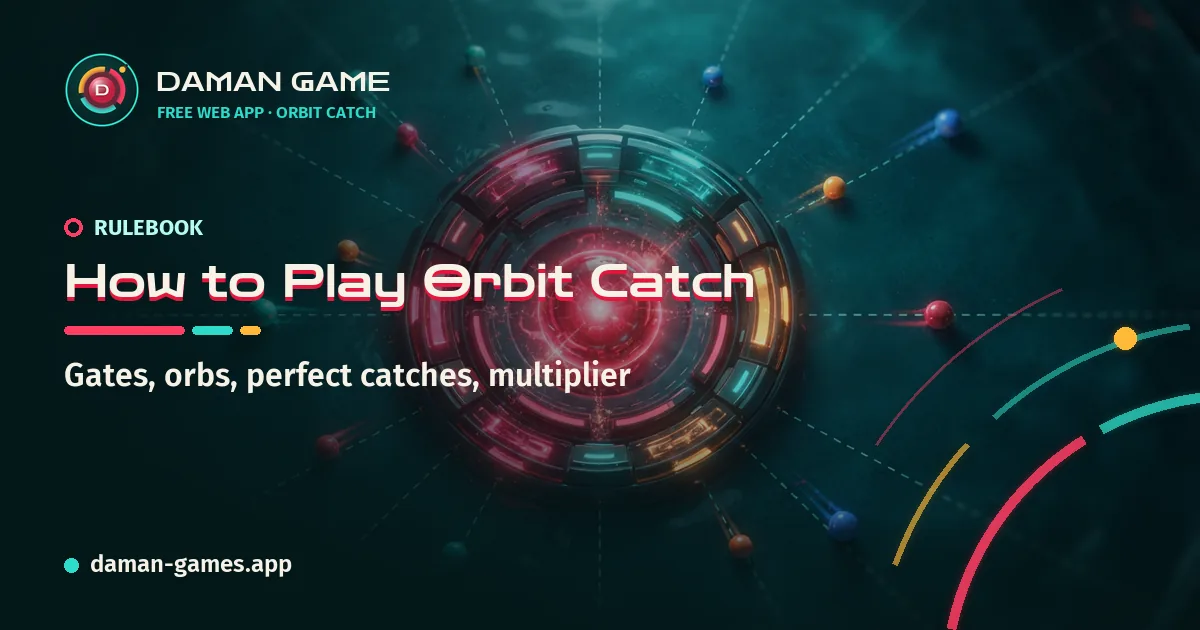
Orbit Catch is the game you open on the Daman Game home page. It looks simple: a ring, a glowing core and a few falling orbs. Under that sits a careful set of rules about timing, colour and streaks, and knowing them is what turns a short run into a long one. This guide goes through all of it in the order you meet it during play.
Want the quick version you can check mid-session? Keep the Orbit Catch rule sheet open in another tab. If you are still deciding whether to add the Daman Game app to your home screen, that page explains what changes once you do. Everything below works the same in the browser and in the installed app.
How Orbit Catch works
The screen is a round field. At its centre glows a crimson core, and around the core sits a ring cut into coloured sections called gates. Orbs appear at random points on the outer edge and travel in a straight line towards the middle. Each orb has one colour. When it reaches the ring, the game looks at the gate directly beneath it at that instant. Matching colour means a catch. Any other colour means a miss.
Before a run you pick one of three modes. The game remembers your last choice, so it is already selected next time.
- Classic gives you three shields. Every miss cracks one, and the run is over when the last one goes.
- Sprint 60 puts a one-minute clock on the screen. A miss takes three seconds off it.
- Zen drops orbs more gently and never punishes a miss beyond losing your combo. It only ends when you choose to end it.
Press Start and the first orb leaves the edge in well under a second. From then on your only tool is the ring.
Rotating the ring by touch and keys
You never move the orbs. You turn the ring so the right gate is waiting when each orb arrives. There are three ways to do it.
- Drag around the field. Put a finger anywhere on the play area and slide it around the core, as if you were turning a dial. The ring turns by exactly the angle your finger travels, so a small arc gives a small turn. You do not need to touch the ring itself; dragging near the outside is often easier because the same turn needs a longer, calmer movement there.
- Hold Left or Right. The two buttons under the field spin the ring anticlockwise or clockwise for as long as you hold them. The spin speed is fixed, and a full turn takes a little under a second and a half.
- Use a keyboard. Hold the left or right arrow, or A and D, for the same steady spin. P or Esc pauses. While paused, P brings you back, and the pause screen also offers End run.
The ring is a circle, so the nearest route to any gate is never more than half a turn. Dragging suits fine corrections; the buttons and keys suit players who like a predictable speed. If you switch tabs or take a call, the game pauses itself, so nothing lands while you are away.
Colour gates and catching the right orb
A run opens with three gates: crimson, teal and amber. Each colour also has a shape. Crimson orbs are circles, teal ones triangles and amber ones squares. If two colours look close on your screen, play by the shape.
The ring changes once you reach twelve catches. A fourth gate in ice blue opens, and ice orbs, drawn as diamonds, start to fall. Four gates now share the same circle, so each one shrinks from a third of the ring to a quarter. The target is smaller exactly when the game is getting quicker, which is why many Classic runs end in the first stretch after the change.
Two more details decide close calls. First, where the orb lands inside its gate matters. The middle 30 % of every gate is the perfect zone, and a catch there earns a bonus. Second, a white prism orb sometimes appears once you have four catches. It fits any gate, so you can let it land wherever the ring happens to be. In Classic it also gives back one shield, up to the full three.
The game is also fair about timing. Orbs are spaced so that two of them never touch the ring less than 0.42 seconds apart. You will never be asked to hold two gates in two places at once.
Combos and how the score grows
Every catch is worth 10 points. A perfect adds 5 more. A prism is worth 25. All three are then multiplied by your combo multiplier, and that is where the big numbers come from.
The combo counts catches in a row, prisms included. The multiplier climbs one step for every five of them and tops out at ×5:
| Catch in a row | Multiplier | Plain / perfect / prism |
|---|---|---|
| 1st to 4th | ×1 | 10 / 15 / 25 |
| 5th to 9th | ×2 | 20 / 30 / 50 |
| 10th to 14th | ×3 | 30 / 45 / 75 |
| 15th to 19th | ×4 | 40 / 60 / 100 |
| 20th onward | ×5 | 50 / 75 / 125 |
One wrong colour sends the combo back to zero and the multiplier back to ×1, in every mode. That is why protecting a long combo is usually worth more than chasing a perfect. A plain catch at ×5 still beats a perfect at ×3.
The pressure builds as you score. Each catch makes new orbs fall a little faster and appear a little sooner, until both reach a fixed limit after roughly the first forty-five catches. Zen follows the same idea with a lower ceiling. A few habits help at speed:
- Turn early, then wait. A ring that is already in place is easier than one still moving at the moment of landing.
- Follow the dashed line on the field. It points at the orb that will land next, so you always know which one to plan for.
- Keep drags short once the ice gate opens. A narrower gate is easy to overshoot.
- In Classic, treat a prism as a repair kit. Do not throw away the combo it extends.
Your best score and where it is kept
When a run ends, the result card shows your score, total catches, perfects and longest combo. If you beat your record for that mode, it says so. From there you can go again in the same mode or switch to another.
Bests are kept one per mode, so a Zen record never hides a Classic one. They are saved in this browser on this device as soon as a run finishes, whether or not you have made a profile. Nothing is sent to a server, and the app never asks for a phone number, an OTP or a password.
A profile is optional. It adds a name and a badge colour, counts your runs and lifetime catches, and shows all three bests together. It also gives you a player code that starts with DGA-. Copy that code, paste it on the app login page of another phone, and your profile and bests move with you. Clearing this site’s data in your browser wipes everything stored here, so copy the code before you do.
That is the full picture: three modes, a ring you steer, gates that shrink at twelve and a multiplier that rewards patience. Pick a mode and put it to the test.